China-Part.by.
From asking whether a part fits to receiving an order: designing a catalogue and customer and manager workspaces for Chinese vehicle parts.
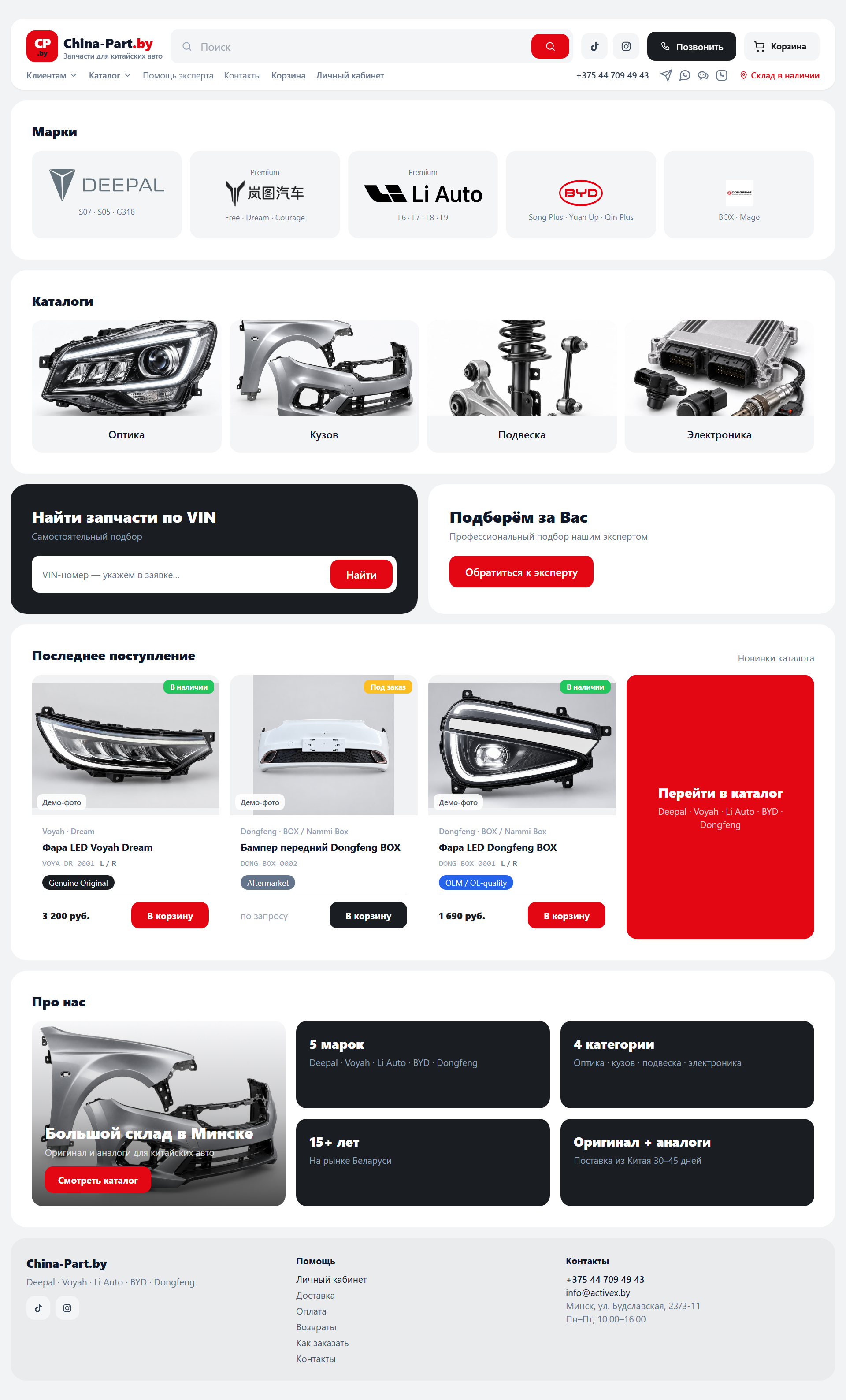
The business challenge
Finding a similar-looking part is not enough. Buyers need to confirm compatibility, availability, price and delivery time. A car owner may know only the vehicle model and the damage, while a repair shop may be looking for a specific part number or repair kit.
The project aims to connect the catalogue, consultation, purchase approval and order fulfilment. Vehicle and part information must stay available throughout the process.
A catalogue backed by expert assistance
The design supports searches by name and part number, make and model selection, and VIN-based enquiries with a description and photos. When there is not enough information to choose confidently, a manager takes over the selection.
Chinese catalogues are considered a source of part information. Prices, stock and order progress are linked to the internal management system. Automatic configuration identification and diagram-based searches depend on the connected source's capabilities.
The complete purchase history in one account
A dedicated customer account brings together vehicles, part selection requests, offers, orders, messages and documents. Returning customers can select a saved vehicle, while conversations remain linked to the relevant request.
The dashboard shows active orders and actions requiring attention. Customers do not need to explain their request again with every message.
From an enquiry to an agreed offer
The manager's workspace combines the vehicle, VIN, request description, photos and correspondence. The manager checks compatibility, confirms the parts, price and collection or delivery terms, then sends an offer to the customer.
Enquiries, offers and orders are separate entities. This allows selection to begin before an exact part number is known and preserves agreed terms: catalogue updates must not silently change an accepted purchase.
One order, different availability dates
Some parts may be in stock while others are awaiting delivery. Readiness is therefore tracked per item, with payment recorded separately from stock movements.
Customers can see what is ready for collection and what is still pending. The designs support collecting parts together or separately while retaining a shared order history.
Data exchange with the management system
We designed two-way data exchange: sending approved orders and receiving reservation, payment, receipt and collection updates. A primary source is defined for each data type.
During a temporary failure, an operation must remain queued, and retries must recognise existing orders. The interactive prototype demonstrates the queue, processing results and a temporary error scenario.
Stage outcome
We prepared a model for interaction between the catalogue and management system, request processing rules and separate interactive customer and manager workspaces. Demonstration data lets users explore scenarios from selection and offers to partial order readiness.
This is the outcome of design and prototyping. Connections to live Chinese catalogues and ERP are not presented as completed integrations.