Kamerton AI.
Work in progress. Speech analytics for the Tomography medical centre: understanding patient needs, identifying service issues and helping the team improve patient care.
Built on an understanding of the business
Kamerton is being developed for the Tomography medical centre. The idea grew out of working inside the company: understanding its telephony, operator workload and the patient journey from the first call to an appointment.
What the business could not hear in its calls
The telephone system stored recordings, but understanding what happened meant listening to them. Reviewing every call manually is difficult. Recurring questions, unmet demand and reasons for unresolved enquiries remained hidden within individual conversations.
Our task is to help identify what the patient wanted, what solution was offered and how the enquiry ended. This analysis helps uncover issues in communication, scheduling and service availability, and select real examples for staff training.
Every enquiry in one place
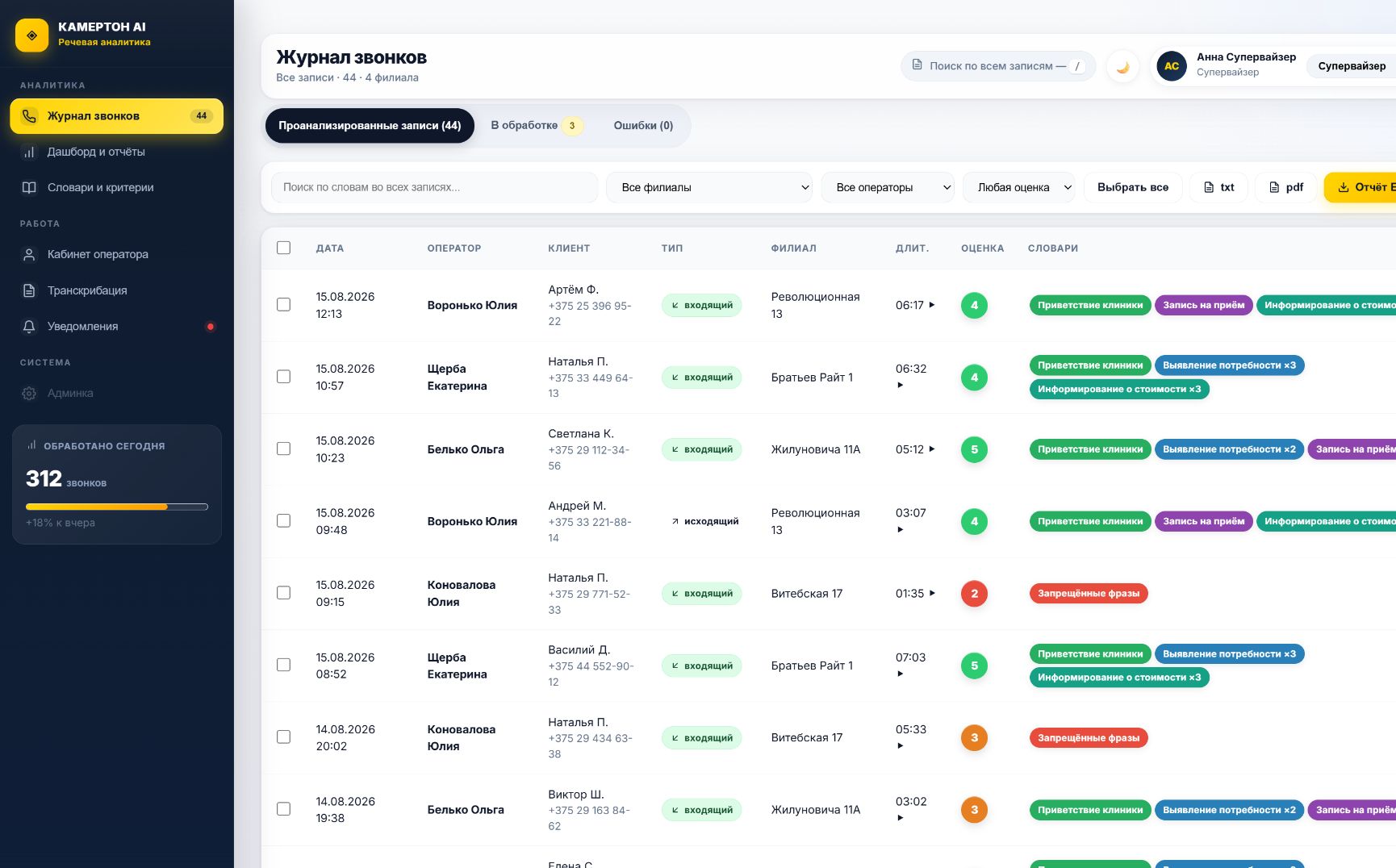
We built a call log with search, filters and access to individual conversation records. Managers and supervisors can select an employee, a period or enquiries that need attention.
From a recording to a clear analysis
Each record includes the audio, a speaker-labelled transcript, a summary and key excerpts. Findings are supported by quotations linked to the audio, so disputed points can be checked against the original conversation.
Evaluation based on company standards
We provided configurable dictionaries, scenarios and quality criteria. The main challenge is context: asking about a price does not necessarily mean declining a service, and suggesting a time does not mean an appointment has been booked.
Experimental semantic analysis does not affect operator scores until its quality has been confirmed. We are checking how accurately the system understands conversations and separates facts from assumptions.
From feedback to staff development
We implemented conversation reviews and tasks for operators, linked to a call and a deadline. Employees see tasks in their accounts and mark them as completed.
Responsibility for training and patient follow-up still needs to be assigned within the organisation.
What managers can see
The system includes branch and employee comparisons, quality indicators and enquiry analytics. We analyse demand, constraints and outcomes separately: new bookings, rescheduling and confirmation of existing appointments need to be counted differently.
We are continuing to validate these indicators. The interface uses demonstration data, not measured implementation results.
How the system fits into daily operations
We implemented recording imports from local and network telephony folders, with different access permissions. Core processing is designed to use local models.
A working CRM connection has not yet been confirmed. Some exploratory analyses were performed separately using an AI agent.
What we are working on now
Kamerton is a working prototype that processes real recordings. We have prepared transcripts of 200 calls, tested semantic analysis and retained the clinic's corrections.
Challenges include recognition errors, speaker confusion, multiple requests within one conversation and patients changing their decisions. We are refining the rules and checking findings against new examples.
The 200 transcripts represent material prepared for validation, not a measure of business impact.